Delaware and Marion Ohio
May 20, 2008
Old State Route 315
Rte 315 in Delaware OH is a pleasantly wooded road that runs along the Olentangy River and has some upper-scale homes along it. At a lane enterning one of these classy neighborhoods, there is a mulched garden bed where for the past week or so there has been a constant crop of this big mushroom.
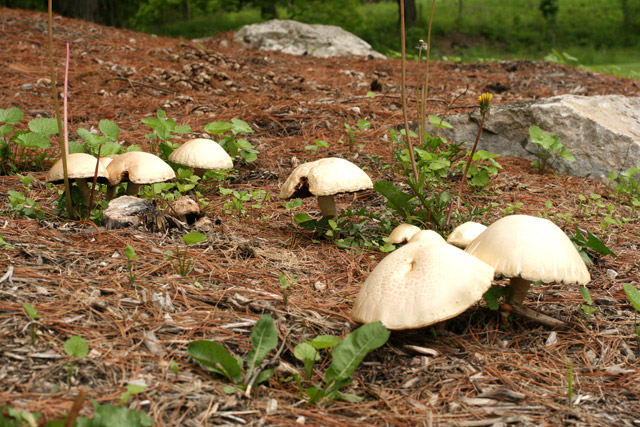
Agrocybe dura on mulched bed along Rte 315, Delaware, OH, May 20, 2008
Fungi like this one are generally called “agarics,” a general term for stalked, gilled mushrooms. Unless it’s a very distinctive one distinguishable by form alone, identification starts with a determination of spore color. This is facilitated by placing a severed fresh cap on a piece of paper and waiting a day. This one has brown spores. Based on the habitat, it seems to be Agrocybe dura.
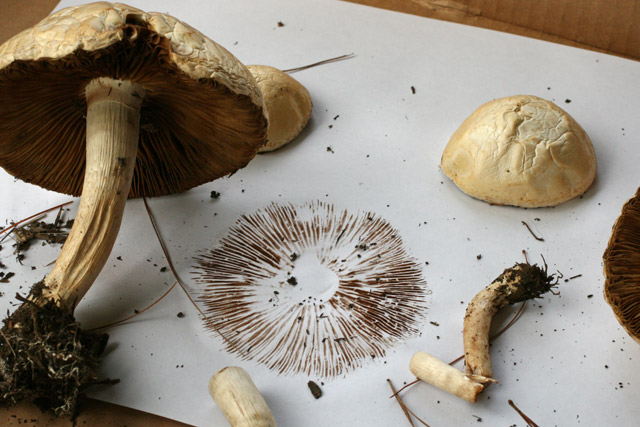
Putative Agrocybe dura spore print showing brown spores
May 20, 2008
Terradise Nature Preserve
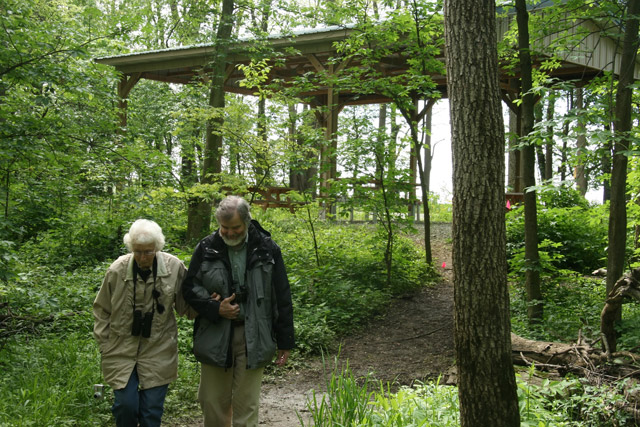
Rich and Trella enjoying hike at Terradise Nature Preserve, May 20, 2008
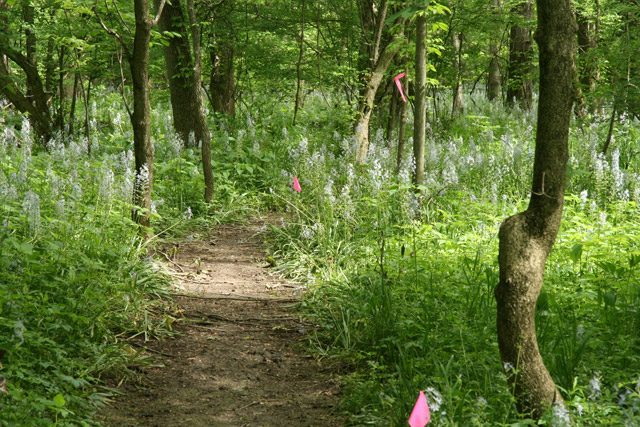
Terradise is a 12-acre nature preserve located alongside the Whetstone River southwest of Caledonia, Marion County, OH that was recently donated to the Marion County Parks District by longtime Marion County resident Trella Romine. She is a versatile and skilled naturalist, keen student and promoter of local history, and devoted conservationist. This morning my friend Rich and I went on a hike there with our friend Trella.
The botanical highlight of the day was the profuse flowering display of the native prairie and woodland wildflower wild hyacinth (Camassia scilloides), a member of the lily family (Liliaceae). Like most monocots, it has linear leaves with parallel veins and the flower parts are in 3’s (or multiples thereof): 3 sepals, 3 petals, 6 stamens, and a pistil consisting of 3 fused carpels. Most members of this family (trillium is a noted exception) have petals and sepals that look alike –colorful, petal-like –and are thus called “tepals.”
Wild hyacinth at Terradise
Wild hyacinth was being visited by honeybees. One another note, a “mystery plant” that occurs here and elsewhere in central OH that would be easy to ID if we were to have ever noticed it at a later stage (in flower). It bears arrow-shaped leaves with a distinctively winged leafstalk. The mystery plant seems like a Prenanthes (family Asteraceae) of some sort. Hmmm.
[Hello…this is Bob from the future speaking. You will eventually see this in flower and know what it is: Nodding Rattlesnake-root (Prenanthes crepidinea)!]
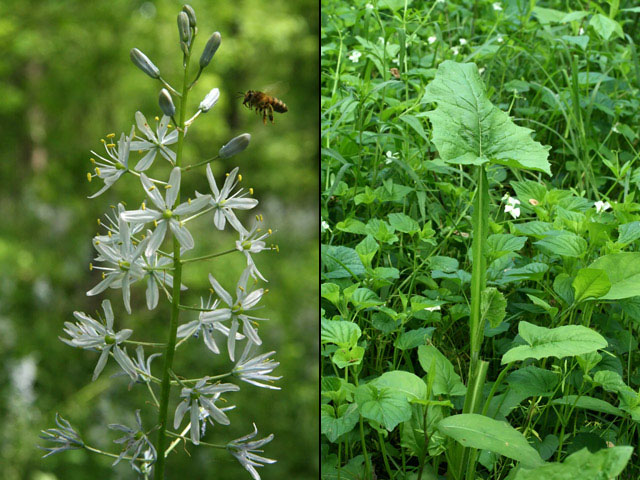
Prenanthes crepidinea and Camassia scilloides
Terradise, May 20, 2008
Terradise is home to some impressive groves of pawpaw (Asimina triloba, family Anonaceae) that were in flower. Trella mentioned that they do produce fruit, and they seem to get eaten pretty quickly by wildlife. We speculated it was opossums that take them.
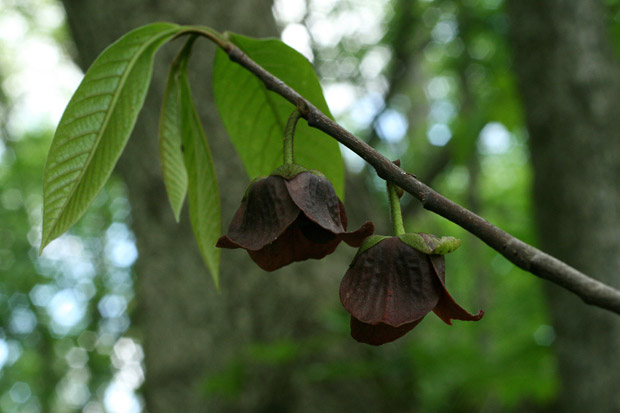
Asimina triloba blossom
May 20, 2008
Violets are still in bloom. An especially abundant species here is the creamy white violet, Viola striata, family Violaceae. The breeding system of violets is interesting in that they produce two types of flowers. Early in the season there are the showy ones we are familiar with, which attract pollinators and produce offspring mainly through cross-pollination. Later in the season, when it seems like the violets are done flowering, they produce inconspicuous ones that self-pollinate in the bud.
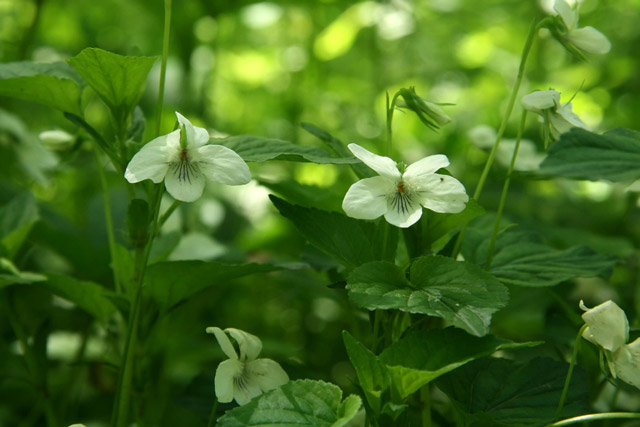
Creamy white violet at Terradise
May 20, 2008.
There is a lot of variation within many plant species. When we saw this green-flowered sessile trillium (Trillium sessile, family Liliaceae), we thought that maybe we were on to something special, perhaps a species we had never encountered before, as normally the flowers of sessile trillium (also called “toadshade”) are a deep maroon. But E. Lucy Braun in “Monocots of Ohio” mentioned that sometimes the flowers are this color. Oh well, not a new species but very interesting anyhow.
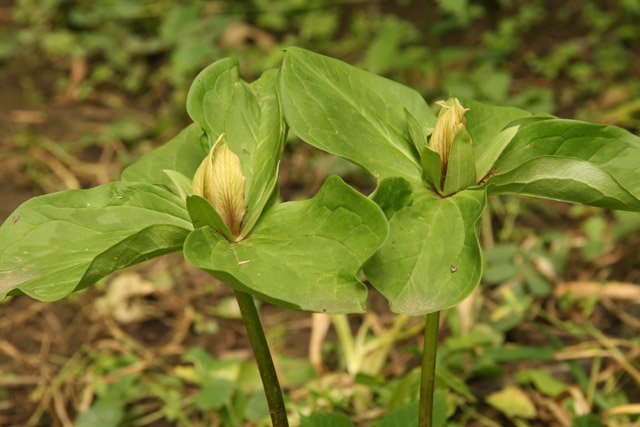
Green flowered form of sessile trillium at Terradise
May 20, 2008.
An interesting aspect of plants is the mechanisms that flowers sometimes employ to reduce self-pollination. The wild geranium, Geranium maculatum, family Geraniaceae, produces flowers that are hermaphroditic (sometimes called “perfect” flowers), i.e., each blossom includes both stamens and pistils. But the timing of maturation is sequential. Each flower goes through a male phase wherein the stamens are ripe and bursting with pollen, but the 5 lobes of the stigma are tightly pressed together, preventing pollen deposition on the receptive surfaces. Within (I guess) a day or two, after the pollen is mostly gone, the stigma are spread out, effectively presenting a surface for pollen deposition by visiting insects.
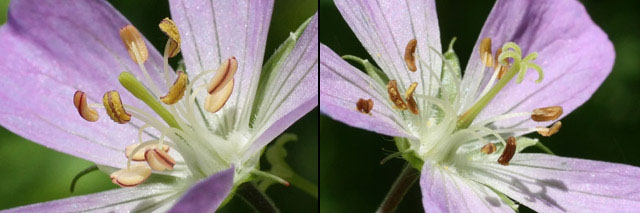
Wild geranum flower details. Left: male phase (note fresh stamens and tightly closed stigma).
Right: female phase (note mostly spent stamens, and spread-out, receptive stigma).
19 May 2008
Delaware Wildlife Area
The Delaware Wildlife Area along Alum Creek at the Marion County-Delaware County border is an excellent place to see spring wildflowers. In mid-April I was there with some friends on a wildflower walk, and saw, on a dry mossy bluff overlooking Alum Creek, this sedge in flower. Evident in the picture are three groups of flowers on each stem, of which the uppermost is staminate (male), bearing elongate pollen-poroducing stamens that are thicker than the pollen-receptive stigmas that are extending out from beneath the scales of the lower pistillate (female) flowers.
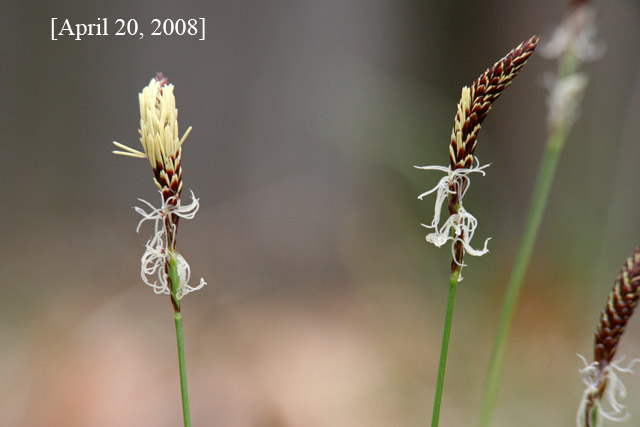
Carex pensylvanica flowering one month ago
Delaware Wildlife Area, Marion County, OH
Here’s the same plant now, with fully mature fruits. The empty scales of the staminate flowers remain even though the stamens are long gone.
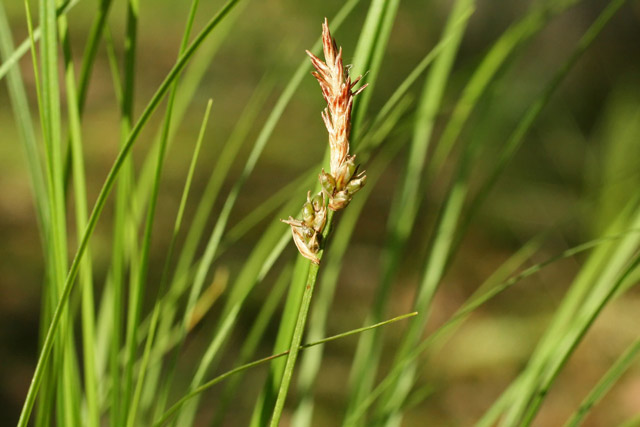
Carex pensylvanica in fruit
May 19, 2006, Delaware Wildlife Area.
The common lousewort (Pedicularis canadensis, family Scrophulariaceae) is flowering at this location. It has dissected, almost fern-like foliage.
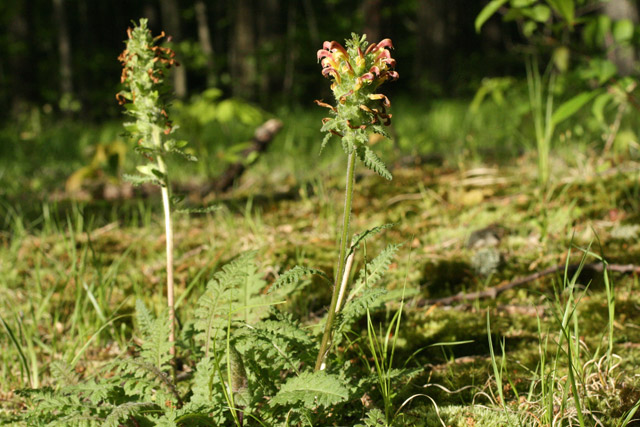
Common lousewort at Delaware Wildlife Area
May 19, 2008.
OSU at Marion Campus
May 19, 2008
The Larry R. Yoder Prairie at the OSU-Marion campus is a diverse 10-acre reconstructed prairie. Three unusual plants recently appeared there. It is interesting to note the prairie was burned about a month ago. Prairie plants are adapted to fire, so perhaps the appearance of these plants is a consequence of the burn. Here’s what the burn last month looked like.
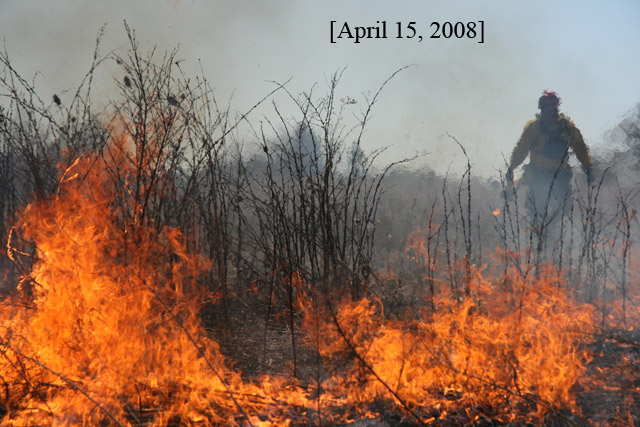
Controlled burn at Larry R. Yoder Prairie
April 15, 2008
Controlled burn at Larry R. Yoder Prairie, April 15, 2008
The exciting plants are low-growing herbs. One of these, bastard-toadflax (Comandra umbellata) is especially abundant, consisting of several hundred plants over an area about 30 m. across. Bastard-toadflax is a “hemiparasite,” meaning that it derives some of its nutrition from other plants in the vicinity, that it connects to through its roots. It looks fairly normal: green and photosynthetic. You’d never guess it has an unusual life style. The little yellow flower at its base is yellow-star grass, Hypoxis hirsuta, which is not a grass at all but instead a member of the Amaryllis family, Amaryllidaceae.
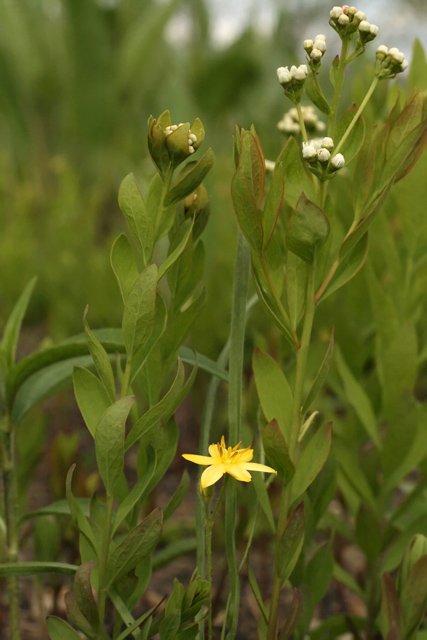
Bastard-toadflax (Commandra umbellata) and yellow-star grass (Hypoxis hirsuta)
Larry R. Yoder Prairie, May 19, 2008
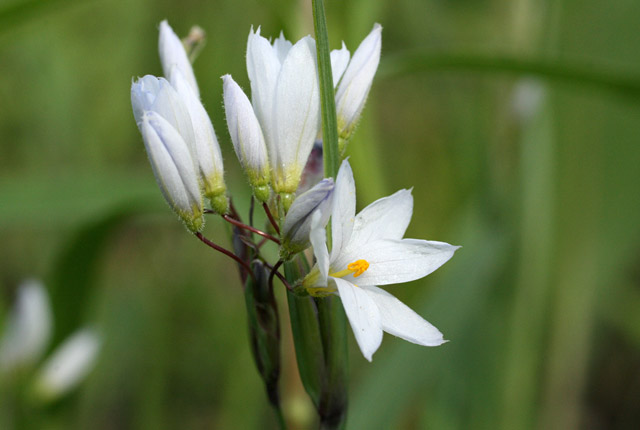
White blue-eyed grass (Sisyrinchium albidum, family Iridaceae)
Larry R. Yoder Prairie, May 19, 2008.
Another plant abundant now is starry false Solomon’s seal (Smilacina stellata). It resembles the more common woodland species S. racemosa but has larger flowers that are in a simple elongate raceme instead of branched panicle.
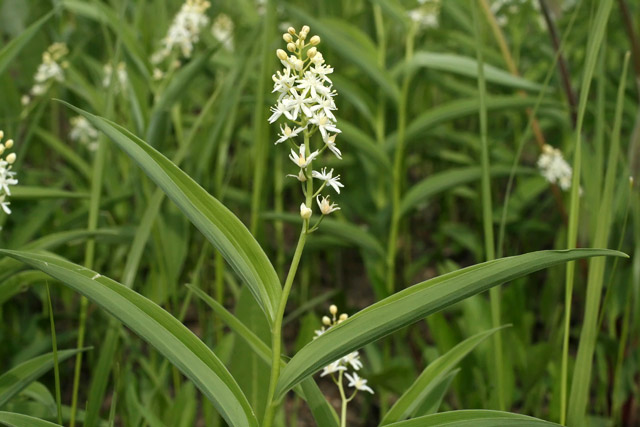
Starry false Solomon’s seal at Larry R. Yoder Prairie, OSU-Marion
Meanwhile, cultivated Scotch pine, Pinus sylvestris near the Student Center is flowering…or whatever it is that non-flowering seed plants do. Gametophyting? Anyhow, the pines have golden yellow grape-like clusters of staminate strobili (pollen cones) that look like they will send off clouds of pollen in the next day or so. Also present are one-year old cones. Pines have a 2 year reproductive cycle. In the spring of the first year they produce ovulate cones that receive pollen. By the end of the first summer, and overwintering, the cones have developed into tightly closed green cones, about half their final size.
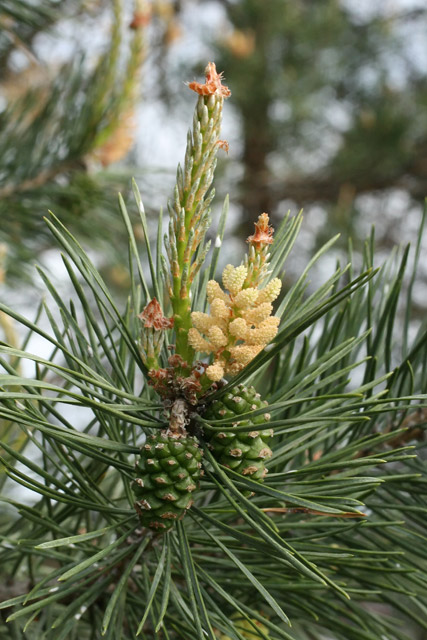
Scotch pine pollen-producing cones and year-old seed cones
OSU-Marion campus, May 19, 2008
Meanwhile, the new seed cones are tiny reddish spiral structures with small scales, and the old (2 year old ones that scattered their seeds lasy autumn) have fallen off the tree and now rest on the ground beneath.
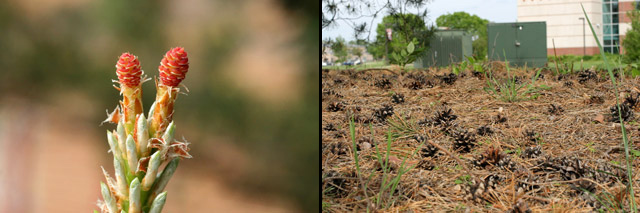
Pinus sylvestis. Left: brand-new baby first-year seed cone
Right: 2-year old seed cones on ground beneath tree